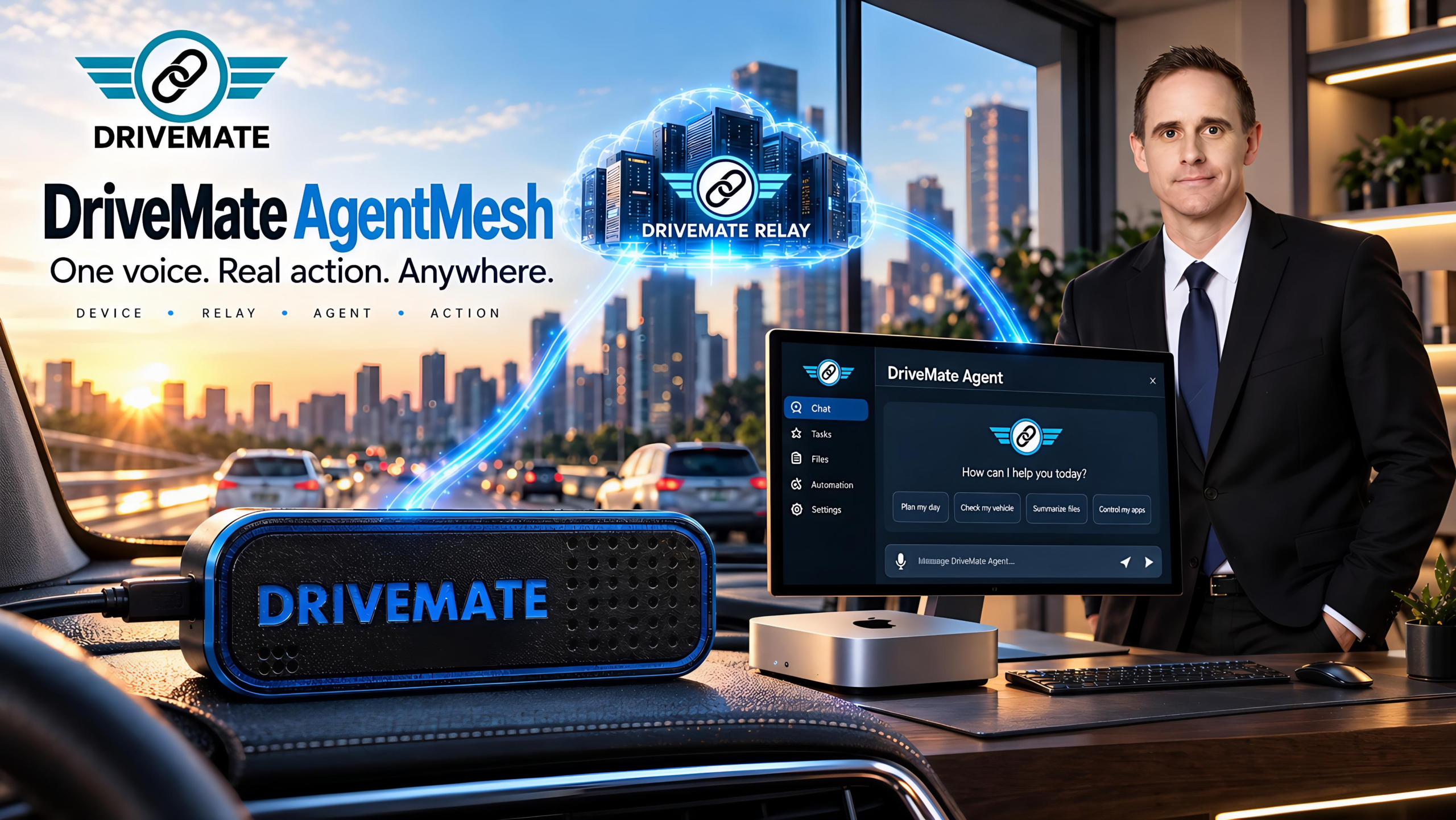
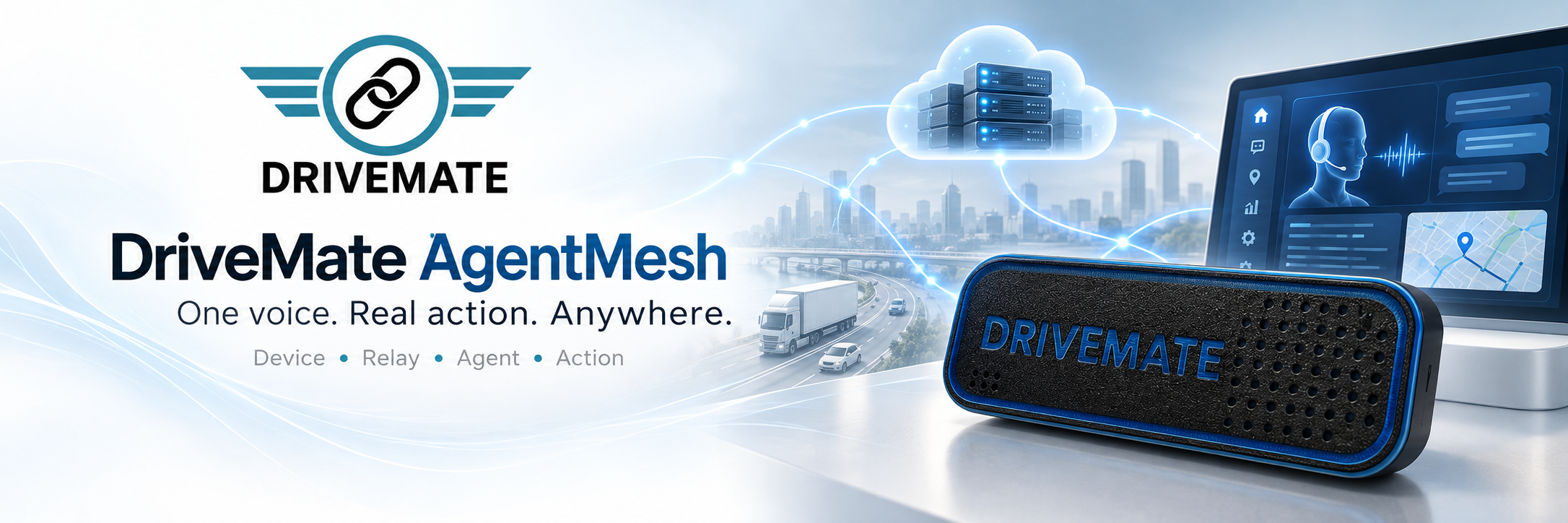
DriveMate AgentMesh is our connected AI architecture that brings together the DriveMate voice device, secure relay infrastructure and a personal AI agent running on a Mac. Instead of stopping at conversation, the system is designed to take a natural voice request, route it to the right tools and return the result back to the user.
DriveMate started with a simple idea: make it easier to talk to AI naturally while driving. The original system focused on hands free conversation. A driver could speak to DriveMate, have that request processed through our relay infrastructure and receive an AI response back through the device as speech. You can also read more about the original DriveMate voice assistant concept here.
That was useful, but we wanted to go further.
We did not want DriveMate to only answer questions. We wanted it to become capable of connecting to a personal computer, understanding what someone is asking for, working with approved tools and connected services, carrying out tasks and then returning the result through the same voice experience.
That is what led us to build DriveMate AgentMesh.
One voice. Real action. Anywhere.
What is DriveMate AgentMesh?
DriveMate AgentMesh connects four main parts of the system:
DriveMate device → Secure relay → Personal Mac Agent → Tools and actions
Each part has a different job, but they are designed to work together as one coordinated system.
The physical DriveMate device is the voice interface. The relay coordinates communication between the device, AI services and the personal agent. The Mac Agent provides the private execution environment. An LLM based reasoning layer interprets the request and determines how the available tools should be used.
The result is a system where a request can begin as a spoken sentence in a car and become a real task carried out inside the user’s own computing environment.
The DriveMate device: the voice interface
The DriveMate device remains the starting point. Instead of opening a laptop, navigating through applications or typing a long command, the user can speak naturally.
A request might be as simple as asking a general question, or it might involve something more personal and task oriented, such as:
- Check my email and tell me what needs my attention.
- Find the document I was working on.
- Look through my cloud files for the information I need.
- Check the latest update on a project.
- Prepare a response for me to review.
Not every request needs an agent. If someone simply wants a normal AI answer, the system can handle that as conversation. When a request requires access to personal information, connected services or tools, AgentMesh provides a path to the personal agent.
That separation is important because the system does not need to treat every request as a computer action.
The DriveMate relay: the coordination layer
Between the physical device and the Mac Agent is the DriveMate relay.
The relay coordinates the communication needed to move a request through the system. Voice can be converted into text, the request can be evaluated, agent tasks can be passed toward the user’s Mac, and completed results can be returned through the same path.
Once the work is finished, the response can move back through the relay and ultimately be spoken through DriveMate.
This means the relay is more than a connection between a device and an AI model. Inside AgentMesh, it becomes the coordination layer between the public voice experience and the user’s private execution environment.
The DriveMate Mac Agent: where real work happens
The most important new part of AgentMesh is the DriveMate Agent running on the Mac.
We built the Mac Agent as its own system before fully connecting it back to the DriveMate device. That was intentional. Before allowing remote voice requests to reach a personal computer, we wanted the local agent itself to have a strong foundation.
The Mac Agent includes its own task system, tool layer, approval controls, persistent services, recovery logic and LLM based reasoning layer.
The language model is not the entire agent. It is the reasoning component inside a larger architecture.
The LLM interprets what the user wants, decides what information or tools may be required, works through the task and determines what should happen next. The surrounding Agent system provides the controlled access, task state, permissions and safety boundaries needed to turn that reasoning into useful work.
This distinction is important. A chatbot can tell you how to do something. An agent can be given controlled access to the tools required to actually do it.
More than 90 tools inside the Agent
Our current DriveMate Mac Agent has grown to include more than 90 available tools.
Those tools allow the Agent to work across different types of tasks while still distinguishing between read only activity and actions that can change something.
That distinction matters. Searching for a message is different from sending one. Reading a document is different from overwriting it. Looking up information is different from deleting something.
The Agent architecture is designed around those differences rather than treating every tool call as equally safe.
What can DriveMate AgentMesh actually do?
The purpose of AgentMesh is to give DriveMate access to a useful personal working environment rather than simply connecting it to another chatbot.
Depending on the services and permissions connected to the Agent, it can work with information across the user’s digital environment. That can include email, cloud documents, files, project information and development resources.
The Agent can search for information, read relevant material, summarize it, compare information from multiple sources and use the LLM reasoning layer to decide whether another step is needed.
For example, a request such as “Check my emails, find anything important from today and tell me what needs my attention” is not just a question. It is a multi step task.
The Agent can interpret the request, use the appropriate connected tools, gather the relevant information, reason about the results and produce one useful response for the user.
Other tasks can involve locating files, reviewing cloud documents, checking project information, preparing text for review or combining information from several connected sources into one result.
The important idea is that the user does not always need to know which application contains the information before asking for it. The Agent can use the appropriate tools as part of the task.
The LLM is the reasoning layer
At the center of the Mac Agent is an LLM based reasoning layer.
Instead of simply receiving a question and generating text, the model can reason about the type of task it has been given.
It can determine that information needs to be searched, decide that a connected service should be queried, inspect the results, decide whether another step is required and stop for approval when an action crosses a safety boundary.
This makes the LLM the decision layer inside a much larger system.
The intelligence comes from the model. The capability comes from the tools. The control comes from the Agent architecture around them.
AgentMesh connects all three.
Every task has a lifecycle
One of the most important parts of the Agent is that tasks are tracked rather than simply fired into the computer and forgotten about.
A task can be waiting, running, completed, failed, waiting for approval or cancelled.
This becomes especially important when the user is interacting with the Agent remotely. Sending a command is not the same thing as proving that the command succeeded.
By tracking task state, the system can report what actually happened instead of assuming success.
Approval before sensitive actions
Increasing capability should not mean giving up control.
The Agent distinguishes between accessing information and performing actions that may have an important consequence.
When approval is required, the task can stop and wait instead of continuing automatically. Only after the appropriate approval does the sensitive action continue.
This is particularly important for operations involving sending information, deleting data, overwriting content, changing sensitive settings or performing other consequential actions.
The principle is simple: the Agent should be capable enough to do useful work, but important decisions should remain under the user’s control.
The Mac does not need to be exposed directly to the internet
Security was one of the main reasons we separated the cloud relay from the personal Agent environment.
The Mac Agent does not need to sit openly on the internet waiting for incoming connections. Instead, the Mac side uses a secure outbound bridge to communicate with the DriveMate system.
It can check for work, claim an appropriate task, process that task locally and return the result.
This keeps a strong separation between the public facing relay and the private computing environment where personal tools and accounts are available.
Designed for recovery when things go wrong
Real systems lose internet connections. Applications crash. Computers restart. Services can stop unexpectedly.
A useful agent cannot assume that every task will run under perfect conditions.
For that reason, we built persistent task state and conservative recovery behavior into the bridge between the relay and the Mac Agent.
We have tested normal end to end operation, service restarts, network interruption and recovery, approval handling and stale task recovery.
When the system is uncertain about whether an action completed, it is designed to recover conservatively rather than making an unsafe assumption.
That is especially important for AI agents. With a consequential action, guessing can be worse than pausing and verifying the state.
What happens when you speak to DriveMate?
The easiest way to understand AgentMesh is through an example.
Imagine saying:
“DriveMate, check my email and tell me if there is anything I need to deal with.”
The DriveMate device captures the request.
The request moves through the relay. When the task requires the personal Agent, it can be handed to the Mac side.
The Mac Agent receives the task. The LLM reasoning layer interprets what is being requested and selects the appropriate tools.
The Agent accesses the permitted information, reviews the relevant results and builds a useful response.
The result is returned through the bridge to the DriveMate relay.
The relay can then return that result to the user through the DriveMate voice experience.
To the user, it can still feel like one conversation. Underneath, several systems have coordinated to complete an actual task.
That is the purpose of AgentMesh.
Where a normal AI assistant stops
Traditional AI assistants are extremely useful for information, writing, brainstorming, translation and problem solving.
But many interactions still end at the boundary between knowing and doing.
An assistant may explain how to search an inbox, locate a document or check a project. The user then has to perform those steps manually.
An agent changes that relationship.
When the correct tools and permissions are available, the AI can perform those steps as part of the request.
The user begins describing the outcome they want instead of operating every interface themselves.
Why we built the Mac Agent first
We could have tried to connect the physical DriveMate device directly to every capability from the beginning.
We chose a different approach.
We built and tested the Mac Agent independently first so we could focus on the difficult parts: tool permissions, task tracking, approvals, cancellation, persistence, recovery and local security.
Only after that foundation was working did we begin connecting it back through the DriveMate relay.
The architecture is now clear:
- The DriveMate device provides the voice interface.
- The relay coordinates communication.
- The Mac Agent provides the personal execution environment.
- The LLM provides the reasoning layer.
- The tools provide the practical capabilities.
- AgentMesh connects them into one system.
One voice, multiple systems
The long term idea is not to create another application that people constantly need to open and operate.
The interface should remain simple. Voice is the starting point. The complexity stays underneath.
A user should be able to speak naturally to DriveMate and ask for something involving their personal digital environment without needing to think about which service or computer should handle every individual step.
That is why we use the word Mesh.
The intelligence is not limited to one device. Different parts of the system have different responsibilities, but they are designed to operate together.
Built around the user’s own environment
The personal Agent runs inside the user’s own Mac environment rather than existing only as an isolated cloud chatbot.
That gives the Agent the ability to work with tools and accounts the user chooses to connect, while keeping the personal execution environment separate from the public relay.
For a business user, that can mean communications, documents and project information. For a developer, it can include repositories and technical workflows. For an individual user, it can become a central interface for finding information and handling everyday digital tasks.
The system can grow as more tools are connected, while the voice interface remains simple.
Where DriveMate AgentMesh is today
The DriveMate Mac Agent is already operating as a working local agent with a large toolset, an LLM reasoning layer, task queues, approval controls, persistent services and recovery mechanisms.
The cloud relay and Mac bridge have also been connected and tested end to end. Tasks can move through the Agent path, execute on the Mac and return their results through the system.
We are now completing the final integration and certification work around the full physical DriveMate experience. That includes automatic routing between ordinary AI conversation and Agent tasks, additional failure testing, reboot and network recovery testing, credential recovery and final security checks.
That distinction matters.
AgentMesh is not simply a concept shown in a diagram. The underlying systems are working. The remaining work is about making the complete experience dependable enough that the user does not need to think about everything happening underneath.
Where we want to take DriveMate next
We do not see the future of DriveMate as simply another voice assistant.
The goal is a personal AI system that can travel with the user through a simple voice interface while securely connecting to the computing power, accounts and tools available elsewhere.
The physical device does not need to contain everything. The cloud does not need to contain everything. The personal computer does not need to contain everything.
Each part can do the job it is best suited to do.
That is the architecture behind DriveMate AgentMesh.
The device gives the user a voice.
The relay connects the system.
The Agent understands and executes the work.
The tools create real capability.
And the user remains in control.
About DriveMate and TradeLink Solution
DriveMate and DriveMate AgentMesh were created by Ryan Mason and are developed through TradeLink Solution Limited. Our work combines product development, AI, connected systems and practical real world use cases with the goal of making advanced technology easier to use in everyday situations. Our DriveMate Privacy Policy provides additional information about how privacy is handled around the product.
DriveMate AgentMesh represents the next stage of that work: taking a voice experience that began in the car and connecting it to a broader personal AI system capable of reasoning, using tools and completing real tasks.
DriveMate AgentMesh
One voice. Real action. Anywhere.